Nia Liston hands its ending song to its own heroines
The Merciless Maiden's ending theme will be sung by an in-character unit of Nia, Hildetora and Reliared, with a newly drawn group visual and comments from all three actors before the 6 October premiere.
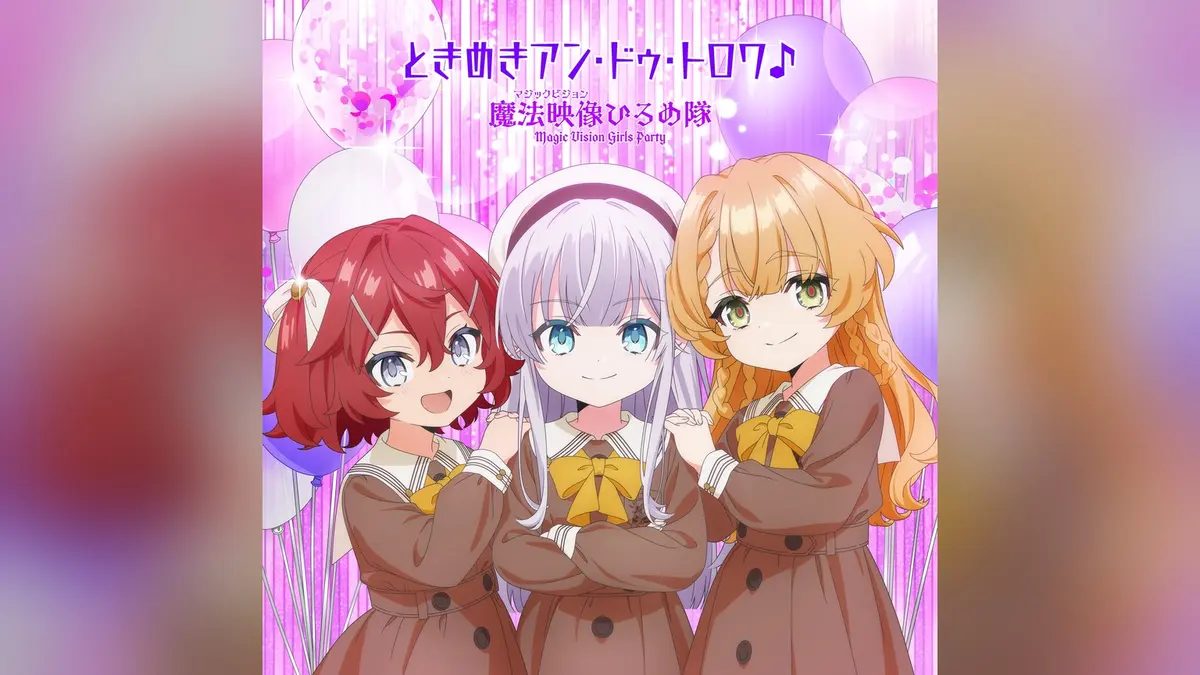
The Merciless Maiden will close every episode with three of its own characters singing. The anime's site confirmed on 22 September that Nia Liston: The Merciless Maiden has an ending theme called Tokimeki Un・Deux・Trois♪ (ときめきアン・ドゥ・トロワ♪), performed by an in-character unit of Nia Liston, Hildetora Altoir and Reliared Silver. Those are the roles of Honoka Inoue, Rina Honnizumi and Rina Hidaka, so the singing cast is the acting cast.
The unit is called Magic Vision Girls Party
The group is named 魔法映像ひろめ隊, and the visual published with the announcement letters the name in English as Magic Vision Girls Party. Magic Vision is the in-story talent outfit the girls work for, and the song is built around the noisier parts of that life: light, cute and written so the three of them trade lines rather than take turns on a chorus. A newly drawn group visual arrived with the announcement, showing the three in their academy uniforms in front of a wall of pink balloons.
It stays sweet only until the second verse
Lyrics and music are credited to 味醂いろは, with tmy joining on composition and handling the arrangement. The site is direct about what the full version does: the mood turns completely in the second verse, where the other half of the character surfaces — the streak of a young lady who enjoys a fight rather more than her doctors would like. All three actors recorded messages alongside the reveal. Honoka Inoue says the more you listen the more your body wants to dance; Rina Honnizumi calls it pop with each of their three personalities packed in; Rina Hidaka says the spoken lines partway through are full of character and hints that the full track keeps one more trick back.
The other end of the episode belongs to a duet
The same day brought the opening side of the record. Tsunomaki Watame's opening theme Respawn!! has had its cover art revealed, and the site says the single also carries a duet with Nia, sung by Inoue. A special event with the main cast has been set for 13 December.
Two cours, starting on 6 October
Nia Liston: The Merciless Maiden begins on Tuesday 6 October on TOKYO MX at 21:25, MBS at 27:30 and BS Nippon TV at 24:30, and it is a two-cour run rather than a single season, which gives an ending theme a long time to be tolerated. Streaming follows the same night on ABEMA, d Anime Store and U-NEXT, with TVer and Nico Nico among the free options in the days after. Motoki Nakanishi directs, KONAMI animation handles production, and the novels run under Hobby Japan's HJ Bunko imprint, with the series past 2.4 million copies in print.
What the show actually is
The premise explains the joke behind the unit. A hero who once killed a god spends their dying wish on meeting somebody strong enough to do the same to them, then wakes up as a frail noble daughter. Nia spends her second life hunting fights, collecting bruises and, between all of that, working as a Magic Vision talent. The novels have passed 80 million page views on the Japanese user-submission site Shōsetsuka ni Narō.
Our opinion
The in-character ending theme is the oldest trick in the playbook and still the most reliable one, because three actors who already know how their characters speak can land a joke a hired band has to be told about. This one is more self-aware than most: the unit exists inside the fiction to promote Magic Vision, and its first song is about the school days its members spend doing exactly that. Telling the same gag twice — once in a bright first verse and once in a second verse that lets the violence out — is the part worth watching, because it matches what the novels are about better than any straight pop tie-in would. The harder job belongs to KONAMI animation, since a two-cour order means this ending will be watched something close to forty times, and the animation that has to keep it alive is the piece nobody gets to hear.